

What counts in life is not the mere fact that we have lived. It is what difference we have made to the lives of others that will determine the significance of the life we lead.” — Nelson Mandela
A spear has fallen – the Spear of the Nation. Nelson Rolihlahla Mandela, father of our nation and first African President of a free, democratic South Africa left us on 5 December 2013. This weekend millions in South Africa and over the world abandoned their normal weekends to attend various prayer and memorial meetings in his honour. His role as President was brief, from 1994 when the ANC was elected by two-thirds of the population in the first free election in our country’s history, to 1999 when he decided not to seek a second term. But his role as our father and grandfather, Tata, and as a great soul who continues to inspire our struggle for justice in South Africa and the world continues unabated.
As a student activist in the 80s I was in awe of this Great Man and everything he represented. The fact that he was imprisoned by the Apartheid government for seeking our freedom as black people was something that inspired us to continue to seek his freedom. Ahmed Kathrada’s god child Shereen Patel, shared letters from Kathy, serving a sentence in Robben Island with Madiba, in which we were given the subtlest glimpses of the life of these stalwarts in prison. Much of the contents of the letters were blacked out in the rigorous and unnecessary censorship that ensured we did not receive messages of incitement. In Benoni, the township where I grew up, and at Wits University in the 1980s, as student activists we mobilised students to conduct protests and boycotts, communities to protest against the denial of basic human rights and to refuse to participate in the sham political structures created to divide the Indian and Coloured communities from the struggle of our African brothers and sisters. We were often beaten, teargassed, arrested and detained by the brutal regime whose security police swarmed our University campuses as spies. Some of our comrades paid for our freedom with their lives – Neil Aggett, Steve Biko, David Webster, Bheki Mlangeni…..Those were the dark days in which we drew inspiration from your 27 years in prison, from your refusal to submit to the demands of the regime and abandon the struggle. I was inspired by your fight against injustice to become a human rights lawyer and to challenge the state of emergency, unlawful detentions and murder of anti-apartheid activists, as well as to support trade unions and civic organisations in their daily struggles to overcome oppressive laws. Those were days of loss and pain but also victorious days of seeing the principles we believed in come alive as the love for our people, which you taught us, burnt away the hatred entrenched in the apartheid system
11 February 1990 is a day etched in my memory – we watched the unbelievable become real as you walked out of prison, a tall proud leader coming to claim your rightful role. The tears flowed and they flowed again when from among thousands at the Union Buildings we watched the Apartheid airforce fly past in a salute shooting rainbow colours of joy into the sky at your inauguration as President. Your oppressors too were humbled enough to claim you as their hero! After casting our first ever votes as free citizens on 27 April 1994, we watched in awe as you led our country towards the ideal state we had so long aspired to build.
I was honoured to be at the first parliamentary session under your Presidency and the party which followed at Fernwood Estate was a celebration of unprecedented joy and love. I watched you dance and laugh and your light shone for all the world to see. I met you a few times after that at various public events and when you held my hand as I tried to introduce myself to you at a lawyers dinner and bellowed your trademark “How are you” as if we had met before, I trembled with joy. We introduced you to our daughter Smita when she was three as you were about to leave to accept the Peace prize in Norway in December 1993, and you spoke to her, a mere unknown child, as if she was the most important person in the world. She feels the imprint of your love and grace till today and is devastated by your loss.
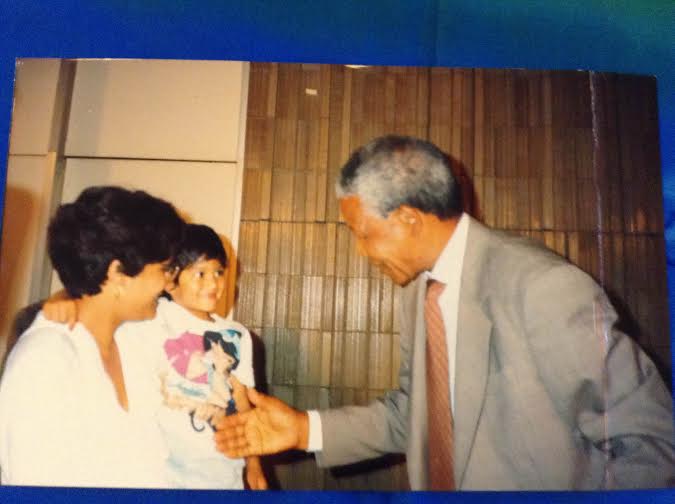
(Urmila Bhoola with her daughter Smita greeting Nelson Mandela)
I often saw you as a grandparent attending school functions at Sacred Heart. How you tried to make yourself ordinary but your extraordinariness shone out to all the world to see. The last time I saw you was at the 80th birthday party of your dear friend George Bizos, and you looked so tired and frail. We felt blessed and joyful to have you in our midst, but it was not to be. The ancestors have now claimed you as one of their own and it is almost as if we are being punished for tarnishing your dream. Your dream was a land based on equal respect, human rights and dignity, but we now have a land where xenophobia, misogyny and racism still prevail with more nuances and complexities than the obvious signs of hatred manifested during the “whites only” years. The gap between rich and poor has widened and South Africa is now considered to be one of the most unequal countries in the world, the landlessness continues with less than 10 percent of arable land redistributed to the poor while extractive industries are allowed to continue their plunder, the unemployment rates are high, with almost 50% of youth unable to find work and decent work is an even more distant dream, housing and service delivery has been a dismal failure with corporate greed and crony capitalism providing distractions to our greedy new leaders. Despite the effective protection for women’s rights and the guarantee of equality in our Constitution, which is heralded the world over, and gives effect to South Africa’s ratification of key international instruments like the Convention on the Elimination of all forms of Discrimination Against Women (“CEDAW”) women and children in South Africa bear the brunt of the highest levels of gender based violence, endemic poverty, lack of adequate access to education, decent work and economic opportunity as well as racial hatred and discrimination. Most painful of all is the lack of political will to create a culture of equal respect and dignity, and to give effect to the principles and values entrenched in our bill of rights. We have a created a society that has shredded to pieces every principle that governed your life so it is no wonder you could not continue to live in it.
The world is reduced to mourning and we are struggling to come to terms with your loss Tata, which we knew was inevitable and yet hoped would not occur. The lessons we learnt from you, of humility without weakness, dignity without capitulation, and strength without oppression, will always serve as guiding beacons in our continued struggle against misogyny, patriarchy, corruption and poverty in South Africa. We hope now that you are gone we will revisit these values and pick up the baton you have left and continue to fight for the world you believed in. Hamba kahle Tata Madiba!
(Guest Writer – Urmila Bhoola, Executive Director IWRAW, Asia Pacific. She lives in South Africa. Urmila’s academic credentials include a Masters in Law from University of Toronto, and several Bachelors degrees in law and in industrial sociology. Urmila’s experience in policy advocacy is highly respected. Urmila was a member of the Labour Court of South Africa. As a Judge of the Labour Court, Urmila worked with the legal community to ensure that the legal system delivered justice and resolution for victims of labour and employment disputes. Urmila was also the Chief Legal Drafter of South Africa’s Employment Equity Act of 1999 – a post apartheid piece of legislation to give effect to the spirit of the new Constitution and correct structural discrimination within the employment sector towards ensuring equality, dignity, and fair practices . Urmila was founder of a consulting organisation called Resolve Group that worked on projects and programmes delivering workplace equity. In Resolve she worked closely with business and government departments. She has also provided specialist legal input to INGOs such as the International Labour Organisation to assist the Nepal government with drafting its new ,labour codes to ensure equality and nondiscrimination. )
8 December 2013
 Hillele